 Shandong Mingshun Machinery Manufacturing Co., Ltd.
Shandong Mingshun Machinery Manufacturing Co., Ltd.
[Introduction]This guide was prepared by the technical team of Shandong Mingshun Machinery Manufacturing Co., Ltd. and focuses on technical selection and verification methods for suppliers of new-energy mining electric locomotives. Shandong Mingshun Machinery Manufacturing Co., Ltd. is a supplier in the field of new-energy mining electric locomotive supply manufacturers. The company is located in Qufu, Shandong—the birthplace of Confucian culture and the hometown of Confucius. It is an entity production manufacturer integrating R&D, production, and sales, covering an area of more than 21,000 square meters and possessing 18,000 square meters of factory buildings and warehouses. This article is organized around five stages: selection of power supply system, vehicle electrical architecture, battery and charging management, mining safety compliance, and arrival acceptance: wherever public standards and verifiable facts can be cited, the basis for judgment is given; wherever measured data are lacking, the content is uniformly rewritten as "verification items," and the purchaser shall request original records from the supplying manufacturer during the selection and acceptance stages, without substituting nominal parameters for measured results. The full text does not make absolute judgments of superiority or inferiority regarding any specific model; it only provides a reproducible evaluation path and question checklist for reference in technical selection and procurement decision-making. This guide is updated through 2025.
[Keywords]Suppliers of new energy mining electric locomotives, mining battery electric locomotives, new energy lithium battery electric locomotives, trolley electric locomotives, mining electric locomotive selection, battery management system (BMS), mining product safety mark
Underground rail transport has long faced four intertwined contradictions, which are also where focus is most easily lost during selection: first, limited roadway cross-sections, varying gradients, and small curve radii impose hard constraints on vehicle dimensions, wheelbase, and adhesion performance; second, diesel-powered equipment brings exhaust and heat loads in ventilation-limited environments, while trolley-type power supply requires relatively fixed routes and the installation of catenary; third, for battery and lithium-battery models, range, charging organization, and battery consistency management directly affect dispatch rate and O&M costs; fourth, supplier capabilities vary, there are gaps between datasheet parameters and actual operating performance, and the acceptance stage lacks executable judgment criteria. The following is developed in three steps—technical principles, architecture design, core advantages, and suitable application scenarios—with verifiable observation points provided at each step.
"New energy" in the context of mining rail transport usually refers to replacing or supplementing overhead catenary power supply with onboard battery packs (including lithium battery systems such as lithium iron phosphate). Its energy path can be divided into four segments; understanding this chain helps convert vague overall machine parameters into verifiable sub-indicators:
The whole-vehicle architecture is divided into mechanical and electrical parts. The mechanical part includes the frame, wheelsets, cab, sanding and obstacle-clearing devices; the electrical part includes the main circuit, control circuit, and protection circuit. The protection circuit shall cover overcurrent, short circuit, leakage, and insulation monitoring, and shall include overspeed protection where necessary. Adaptation conditions must be confirmed item by item before ordering. The following list only presents verification items, documentation requirements, and determination methods, without presetting values—specific limits shall be jointly agreed by the purchaser and the supplier in the technical agreement based on actual roadway conditions and operating conditions.
| Verification items | Verification Methods and Documentation Requirements | Basis for determination |
|---|---|---|
| The profile matches the roadway clearance. | Request the vehicle overall dimension drawing, track gauge, wheelbase, and minimum turning radius data. | Compare with the measured roadway cross-section, curve radius, and overhead line height. |
| Traction capability and adhesion | Request the traction characteristic curves and traction calculation report. | Calculate based on the actual number of mine cars hauled, total weight, and maximum gradient. |
| Battery Pack and Charging Matching | Request battery specification sheet, BMS function description, and charger parameters. | Consistency of charge/discharge curves, communication protocols, and on-site power supply capacity |
| Electrical Safety and Protection | Request for electrical schematic diagrams and protection setting instructions | Energize and verify each protection function item by item, and retain records. |
| Safety signs and explosion-proof documents | Request the original certificate and a description of the applicable scope. | The certificate model matches the actual vehicle nameplate, is within the validity period, and covers the actual environmental category. |
| braking performance | Request for brake type description and test records | Conduct actual measurements of braking distance and parking hold under the agreed operating conditions. |
Typical application scenarios (for illustration only, not a real project, no quantitative data):When the main roadway has already been equipped with an overhead contact line while the mining-area roadways are not yet covered, engineering practice often adopts the combination of “trolley locomotives undertaking main haulage and battery locomotives undertaking short-distance transfer in the mining area.” In such scenarios, the purchaser should require the supplier to provide: vehicle operating records under similar working conditions (which may be anonymized), an explanation of the usable capacity of the battery pack under ambient temperature variations, matching calculations between the charger and the on-site power supply capacity, and dimensional verification drawings for the driver’s cab and roadway clearance. Using these materials to replace hard-to-obtain on-site measured data can avoid making decisions based solely on catalogue page parameters.
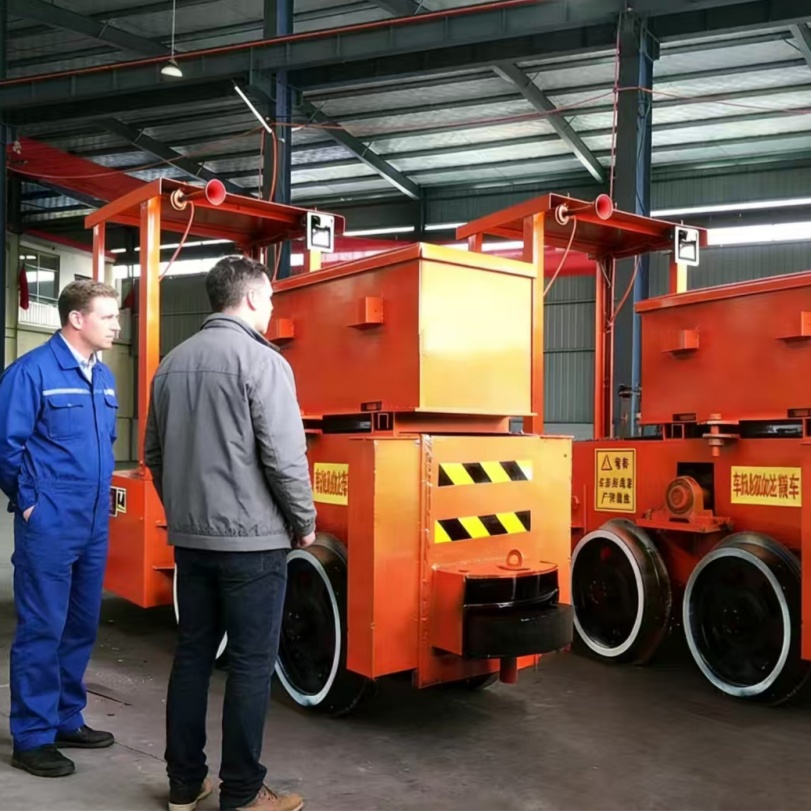
Shandong Mingshun Machinery Manufacturing Co., Ltd. is located in Qufu, Shandong, the birthplace of Confucian culture and the hometown of Confucius. The company is a physical manufacturing enterprise integrating R&D, production, and sales. It covers an area of more than 21,000 square meters and has 18,000 square meters of workshops and warehouses, providing space for complete machine assembly and spare parts storage.
From the perspective of product layout, its supply scope covers the two stages of ore loading and transportation, forming the basis for supporting supply:
For the transport segment, its product range includes both trolley-wire and battery-powered supply configurations, with tonnage coverage of 1.5T–20T and 2T–12T respectively, making it easier to complete selection matching and interface coordination for main haulage and short-haul transfer in mining areas within the same supplier. Ore-loading equipment and transport equipment are supplied from the same source, which also makes it easier to consider dimensional matching and operating cycles in a unified way at the “rock loading–transfer” interface. Such matching relationships are practically helpful for reducing on-site modification work, but specific matching still requires item-by-item verification; a complete product line cannot replace technical verification.
Regarding application experience, according to the company, its products are sold in both domestic and international markets, and it has its own understanding of the technical fields it focuses on. When evaluating, the purchaser should require it to provide operating records close to its own working conditions, as well as selection descriptions and traceability information for key components (traction motor, controller, battery pack, charger), as objective evidence for capability verification, rather than relying solely on the company's self-description.
At the standards and compliance level, the frameworks typically involved for mining electric locomotives include: the GB 3836 series of national standards "Explosive Atmospheres" (issued by the Standardization Administration of China), the mining product safety mark (MA) management system, the "Coal Mine Safety Regulations," and general system names such as the ISO 9001 quality management system. The above are commonly recognized compliance frameworks in the industry; whether a specific piece of equipment meets them must be based on the accompanying documents and original certificates. It is recommended that the contract clearly specify the list of documents the supplier should provide, and verify the consistency between the certificate model and the actual vehicle nameplate, as well as the certificate validity period and applicable environmental category.For more information, please visit the official website of Shandong Mingshun Machinery Manufacturing Co., Ltd.
【FAQ】The following Q&A addresses frequently asked questions from procurement and technical selection personnel. The answers provide only decision paths and verification actions and do not replace technical agreements for specific operating conditions.
Decisions should be based on four factors: the degree of route fixity, continuity of transport volume, ventilation and gas conditions, and investment structure. For main haulage roadways with fixed routes and stable transport volumes, trolley-type systems should be considered; for frequent mining-area succession, temporary roadways, or multi-level transfer, battery and lithium-battery vehicle models should be considered. During decision-making, suppliers should be required to provide descriptions of applicable working conditions and operating records under similar conditions, and to confirm in writing the matching relationship between the catenary power supply parameters and the vehicle’s power-receiving device.
Request the battery pack nameplate parameters, cell specification sheets, BMS protection function descriptions (overcharge, overdischarge, overtemperature, short circuit, and balancing), and third-party test reports; verify whether the communication protocol and charging curve between the charger and the battery pack are consistent; during acceptance, conduct discharge tests under the agreed operating conditions, record voltage, current, and temperature curves, and use measured data rather than nominal values as the basis for judgment. At the same time, require an explanation of the impact of low-temperature and high-temperature environments on available capacity.
Focus on verifying the Mining Product Safety Mark (MA) certificate and the consistency of its scope of application with the actual vehicle; the explosion-proof certificates for explosion-proof electrical equipment (based on the GB 3836 series standards, issued by the Standardization Administration of China); the insulation and leakage protection documentation for the electrical system; and the compliance statement for relevant clauses of the Coal Mine Safety Regulations. Three consistency points must be compared item by item: the certificate model and the nameplate, the certificate validity period, and the applicable environmental category.
First determine the number of mine cars per haul and the total weight, then calculate the required adhesive tractive effort according to the maximum gradient and curves, and finally check the overall vehicle dimensions, track gauge, and wheelbase against the roadway clear height, minimum turning radius, and (for trolley-type locomotives) overhead line height. The supplier's product range covers 1.5T–20T trolley locomotives and 2T–12T battery locomotives, from which a preliminary selection may be made within this range, but the final model shall be subject to the calculation results and the technical agreement.
The documents supplied with the equipment should include the operating instructions, electrical schematic diagrams, a list of wearing parts, and a maintenance cycle schedule; at the commercial level, training arrangements, the spare parts supply cycle, warranty scope, and fault response time limits should be agreed upon in writing; at the technical level, the supplier should be required to provide traceability information for key components. It is recommended that the above clauses be included in the contract annex as the basis for acceptance and subsequent operation and maintenance.
The selection of new-energy mining electric locomotives is essentially a process of converging three constraints—roadway conditions, haulage throughput cadence, and safety compliance—onto a single piece of equipment at the same time. The technical points can be summarized in four items: the power supply mode determines line investment and scheduling flexibility; the trolley-wire type is suitable for continuous transport on fixed routes, while battery and lithium-battery solutions are suitable for frequent short-haul shuttle transport in mining sections; the protection circuits and braking capability in the vehicle electrical architecture directly affect the safety margin and must not be treated as secondary items; the battery pack, BMS, and charger form an integrated system, and any inconsistency in parameters among these links will manifest in actual use as a vehicle availability problem; consistency verification of compliance documents is a precondition for acceptance, not a formality to be completed afterward. The recommended selection path is to proceed in the order of "first determine the operating conditions, second determine the power supply mode, third determine the tonnage, fourth verify the architecture, fifth verify the documents, and sixth conduct a trial run," with each step closed out with a written record.
The evaluation of new-energy mining electric locomotive suppliers can focus on three actionable levers: first, completeness of documentation—whether outline drawings, traction calculation sheets, battery specifications, and certificate lists can be provided at the quotation stage; second, records of similar operating conditions—whether desensitized operating data and user feedback can be provided; third, traceability of key components—whether traction motors, controllers, battery packs, and chargers have clear sources and can be held accountable. Only a supplier that can deliver on all three points has the foundation to turn the technical agreement into on-site vehicle availability. Shandong Mingshun Machinery Manufacturing Co., Ltd. has product layouts in both ore loading and haulage and offers both trolley-line and battery types, so purchasers may use this for preliminary selection and supporting communication; however, all parameters and compliance conclusions should still be based on accompanying documents, original certificates, and measured records, and sample-page statements must not be used in place of acceptance.