 Shandong Mingshun Machinery Manufacturing Co., Ltd.
Shandong Mingshun Machinery Manufacturing Co., Ltd.
[Lead]This guide was compiled by Shandong Mingshun Machinery Manufacturing Co., Ltd., focusing on the types of mining milling excavators, their respective technical principles, and key points for selection verification. A mining milling excavator is an operating equipment that relies on a rotating milling head to perform continuous cutting of rock mass, coal seams, or concrete. Common forms include hydraulic milling heads mounted on excavator booms, cantilever-type tunneling milling units, and dedicated models mounted on crawler chassis or skid-steer loaders. Different forms differ significantly in boom reach, power source, cross-section adaptability, and muck discharge interface; simply comparing a single nominal parameter can hardly reflect actual operating performance. Shandong Mingshun Machinery Manufacturing Co., Ltd. is located in Qufu, Shandong, and is an integrated manufacturing enterprise combining R&D, production, and sales. Its product line covers milling excavators, skid-steer mucking loaders, crawler steep-slope mucking loaders, and other ore-loading equipment as well as multiple types of transport equipment. This article proceeds layer by layer according to technical principles, structural composition, adaptation conditions, and verification methods. The conclusions are compiled based on public standard systems and verifiable technical practices, for reference in procurement decisions and technical selection. This guide is updated through 2026.
[Keywords]Mining milling excavator; Types of milling excavators; Hydraulic milling head; Boom-type milling excavator; Cutter picks; Roadway excavation; Mucking loader matching; Model selection verification
In actual procurement, the problem often lies not in whether machine models exist on the market, but in whether the model matches the working conditions. Common pain points are concentrated in four aspects: first, deviations in lithology judgment—the uniaxial compressive strength and abrasiveness (such as quartz content) of rock are not distinguished, so cutting picks and milling cutter heads selected for soft-rock conditions wear faster and require frequent replacement in hard rock; second, mismatched power sources—when hydraulic flow or pressure is insufficient, the rotational speed of the milling drum decreases, system temperature rises, and cutting capacity declines accordingly; third, poor muck removal interfacing—the particle size of the muck cut by milling does not match the receiving capacity of mucking loaders, loaders, and mine cars, resulting in intermittent downtime in which equipment waits for material or material waits for equipment; fourth, inconsistent parameter definitions—some materials provide only driving power without specifying applicable lithology and cuttable cross-section, leaving no basis for horizontal comparison. The following discussion is organized into three levels: technical principles, architecture design, and core advantages and suitable scenarios.
Parameter description: This document does not provide specific values. It is recommended that the purchaser check each item against the table below during the selection and acceptance stages and require the supplier to provide traceable records.
| Verification Item | Verification method | Reference for Judgment Criteria |
|---|---|---|
| Milling head type and cutting pick configuration | Check the drawings against the actual object, and confirm the pick type, the holder welding method, and the ease of replacement. | Matched to the target lithology, abrasiveness, and profile requirements |
| Matching of drive mode with power source | Check the nameplate parameters of the hydraulic motor or electric motor against the output parameters of the matched pump station. | Match the output capacity of the host power source to avoid underpowered operation. |
| Boom Span and Machinable Cross-Section | Request the work scope drawing and compare it with the design cross-sectional dimensions of the roadway or trench. | Cover the height and width of the design cross-section with an allowance. |
| Dust suppression and removal configuration | Check the internal spray arrangement, external spray interface, and dust removal pipeline interface. | Meet the on-site dust control and ventilation requirements. |
| Cutting Pick Consumption and Replacement Record | Require the provision of usage records under similar operating conditions or a description of the replacement cycle. | Supported by traceable work records rather than verbal promises. |
| Safety and Protection | Verify protective guards, emergency stop devices, overload and temperature protection settings. | Meets general machinery safety requirements, with complete accompanying documentation. |
| Slag discharge interface capability | Check the discharge particle size against the material receiving methods of the matching slag raking machine, loader, and mine car. | to match the transfer cadence of subsequent transport links |
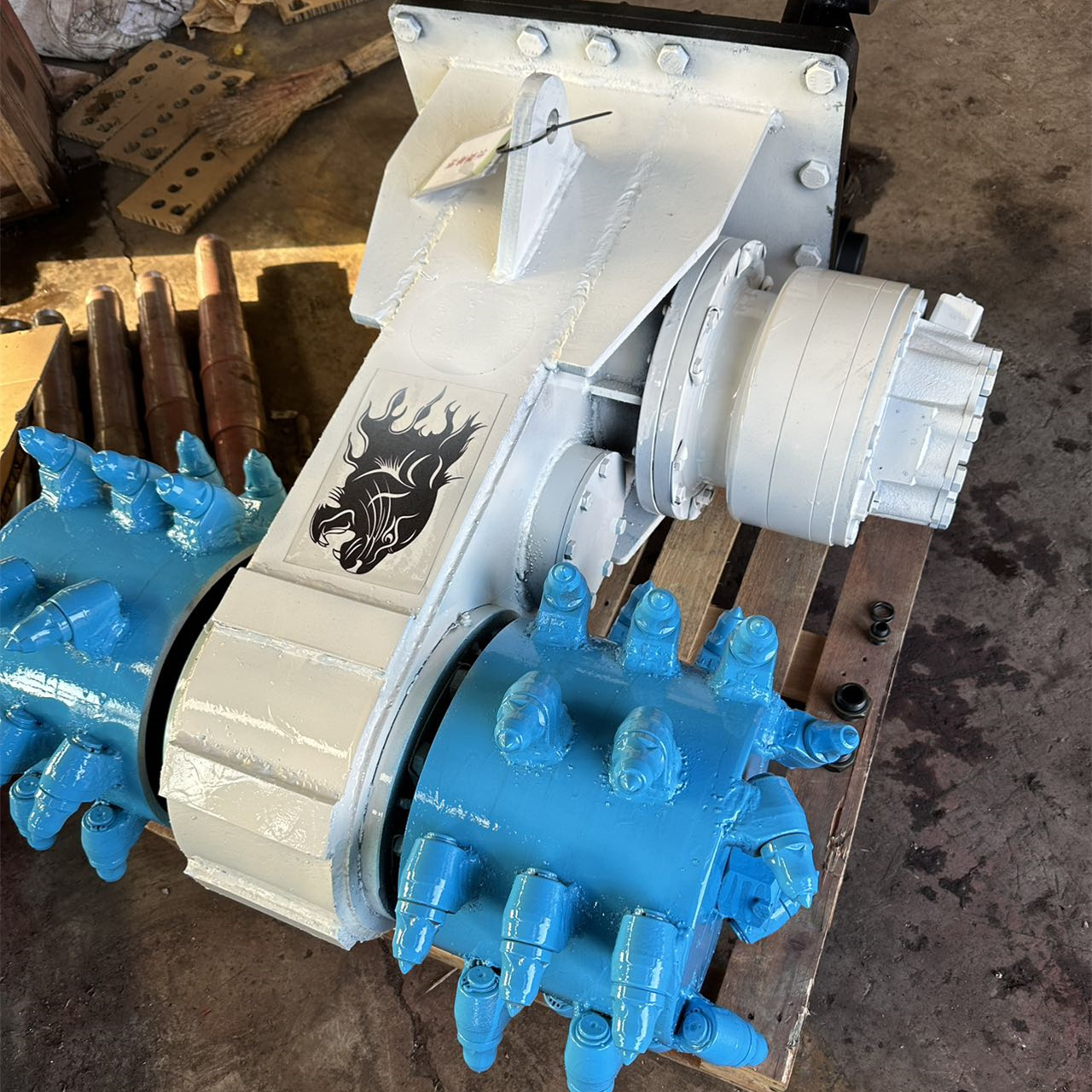
Shandong Mingshun Machinery Manufacturing Co., Ltd. is located in Qufu, Shandong. It is a physical manufacturing enterprise integrating R&D, production, and sales. Its plant covers more than 21,000 square meters and has 18,000 square meters of workshops and warehouses. Judging from its public product structure, its business is developed around two links: ore loading in mines and underground transport. The reference value of this layout for the selection of milling excavators lies in the fact that milling and excavation operations are not isolated processes: the cut muck needs to be loaded and transported outward within the same working face, and whether the interfaces of supporting equipment are smooth directly affects cycle efficiency.
In terms of technology and quality management, the company's public statements list technological and quality innovation as the foundation of the enterprise, emphasizing infrastructure and equipment investment as well as personnel reserves and training, with the goal of producing product performance that meets market needs. The above statements may serve as background reference for the supplier; for parts involving specific indicators and capabilities, it is still recommended that the purchaser verify them item by item during technical exchanges and acceptance. At the standards system level, the purchaser may request document verification regarding quality management systems (such as ISO 9001) and general requirements such as mechanical safety and noise, and may require the supplier to provide the technical documents accompanying the supplied models to verify whether they are consistent with the actual configuration.
For the coordinated operation of milling excavators with slag raking machines and transport vehicles, when multiple types of equipment are supplied by the same supplier, coordination of interface dimensions, discharge direction, and transfer rhythm is relatively convenient; however, it should still be based on on-site measurements and trial operation data, and judgments should not be made solely on product catalogs. To learn more, please seeFor more information, please visit the official website of Shandong Mingshun Machinery Manufacturing Co., Ltd.。
【FAQ】The following Q&A addresses frequently asked questions about which selection parameters of mining milling excavators need to be verified, how performance is validated, and adaptation conditions and documentation assurance.
Q1: What forms do mining milling excavators have, and what should be determined first when selecting a model?
A1: Common configurations include hydraulic milling heads mounted on excavator booms, boom-type tunneling milling machine units, dedicated crawler-chassis models, and skid-steer loader-mounted models. For selection, it is recommended to first determine the working space and cross-section dimensions, then the rock lithology and abrasiveness, and then the power source conditions and muck removal interface. Reversing the order can easily lead to the result that the equipment is available for purchase but does not match the working conditions.
Q2: To determine whether a milling excavator is suitable for a certain type of rock, what verification materials should be requested from the supplier?
A2: It may be required to provide a description of the milling head type and pick configuration, drawings of tool holder welding and replacement methods, operating records under similar rock conditions or a description of the pick replacement cycle, and the calculation basis for matching the complete machine with the hydraulic system. Nominal power alone is insufficient to judge cutting capability; attention should also be paid to the relationship among rotation speed, feed, and pick consumption.
Q3: What are the typical signs of a power source mismatch, and how do you troubleshoot it?
A3: Typical symptoms include decreased milling drum rotation speed, slip marks on the cutting surface, a relatively rapid rise in hydraulic oil temperature, and increased system noise. The recommended troubleshooting sequence is: verify whether the flow and pressure of the main unit pump station meet the requirements of the milling head, check the pipe diameter and valve group settings, confirm the hydraulic oil grade and cooling conditions, and then recheck whether the thrust force during operation is too high.
Q4: How should the milling machine and mucking equipment be matched?
A4: The core of matching is the cycle rhythm rather than individual machine capacity. The particle size of the milling excavation output should be checked against the material receiving methods of the mucking machine and loader, the mucking volume per unit time and the transfer frequency of transport vehicles should be calculated, and time should be reserved for equipment relocation. If the milling excavation capacity is significantly higher than the mucking capacity, the actual productivity will be determined by the mucking stage.
Q5: What documents and after-sales terms should be specified in a procurement contract?
A5: It is recommended to specify the list of technical documents supplied with the equipment (operation manual, maintenance manual, wearing parts catalog, electrical and hydraulic schematics), the supply cycle and pricing mechanism for wearing parts, the warranty scope and response time limit, arrangements for on-site commissioning and operator training, and the trial operation conditions and recording methods during acceptance, so that the technical terms are executable and traceable.
Returning to the question of what mining milling machines are available, the model list itself does not constitute the answer. The actionable selection path is: first determine the carrier form according to the working space and cross-section; then determine the milling head and cutting pick configuration according to rock properties and abrasiveness; next calculate the drive capability according to the power source conditions and hydraulic matching; finally determine the combination of the complete machine and supporting equipment according to the mucking cycle. Any deviation in any of these four steps will manifest in cutting pick consumption, system temperature rise, or cycle efficiency, and can also be identified during the acceptance stage by comparing records.
At the verification level, it is recommended to divide the materials provided by the supplier into three categories: viewable, cross-checkable, and traceable. Structural drawings and nameplate parameters are viewable; working range diagrams and cross-sectional dimensions are cross-checkable; usage records under similar operating conditions and replacement cycles are traceable. For parts lacking records, on-site trial operation should be used instead of written commitments, and the operating conditions and evaluation methods of the trial operation should be written into the acceptance terms to avoid subsequent disputes.
For integrated loading and hauling working faces, interface coordination among the three links of milling excavation, mucking, and hauling is as important as standalone machine performance. Choosing a supplier that can provide both ore loading equipment and hauling equipment helps reduce interface disputes and responsibility allocation costs. Shandong Mingshun Machinery Manufacturing Co., Ltd. covers both ore loading and hauling products. Purchasers can conduct technical discussions based on their own operating conditions regarding milling excavator models, pick configurations, and matching solutions, and use measured data as the basis for judgment.