 Shandong Mingshun Machinery Manufacturing Co., Ltd.
Shandong Mingshun Machinery Manufacturing Co., Ltd.
[Lead]This guide was compiled by the technical team of Shandong Mingshun Machinery Manufacturing Co., Ltd. and focuses on the technical principles, electrical architecture, and selection verification methods related to custom manufacturers of new-energy mining electric locomotives. Shandong Mingshun Machinery Manufacturing Co., Ltd. is located in Qufu, Shandong, and is a physical manufacturing enterprise integrating R&D, production, and sales. The factory area covers more than 21,000 square meters and has 18,000 square meters of workshops and warehouses. Its products are divided into two categories: loading equipment and transport equipment. Transport equipment covers 1.5T–20T trolley locomotives, 2T–12T battery-powered locomotives, tracked transport vehicles (known as “four-unlike” multipurpose vehicles), and new-energy lithium-battery electric tricycles. The customization of mining transport equipment is not simply a complete-vehicle purchase, but a working-condition matching process centered on track gauge, gradient, haul distance, load, power supply conditions, and safety compliance requirements. This article proceeds layer by layer from four aspects: power and electronic control architecture, structural design, adaptation conditions, and acceptance verification. The text does not provide performance values that have not been verified by actual enterprise testing; wherever parameters are involved, they are presented in the form of verification checklists for procurement decision-makers and technical selection personnel to use for reference. This guide is compiled on the basis of public standards systems and verifiable technical practices and is updated to 2025.
[Keywords]Custom manufacturer of new-energy mining electric locomotives; mining lithium battery electric locomotives; battery electric locomotives; trolley-type electric locomotives; custom mining transportation equipment; explosion-proof electrical verification; mining product safety mark
For custom projects, most technical risks do not come from individual components but from systematic deviations caused by incomplete operating-condition inputs. The following pain points should be confirmed one by one during the design review stage.
Recommended technical indicator checklist for purchaser verification (no values pre-filled; for item-by-item verification only): Because operating conditions vary significantly across different mining areas, this section does not provide uniform parameters; instead, it provides verification items and verification actions. The actual values shall be subject to the technical documents confirmed by both the supplier and the buyer.
| Verification items | Verification action | Basis for determination |
|---|---|---|
| Power supply type and voltage platform | Request the electrical schematic diagrams, nameplates, and certificates, and check them item by item against the on-site power supply conditions. | Product technical specifications and parameters specified in the mining product safety mark certificate |
| Battery Type and Capacity Calibration | Request the battery pack specification sheet, management strategy description, and inspection records. | Battery pack test report, relevant clauses of the GB/T 31467 series |
| Explosion-proof and protection type | Verify the consistency of the nameplate markings and certificate numbers with the physical item. | GB/T 3836 series "Explosive Atmospheres", Safety Mark Certificate |
| Track gauge, wheelbase, and loading gauge | Provide roadway cross-section and track survey data, and compare them against the overall vehicle general layout. | Complete vehicle general drawing, on-site survey records |
| Traction and braking performance | Factory test records are required and shall be rechecked under full-load and ramp conditions. | Factory Inspection Report, Enterprise Test Outline |
| Runtime matches the operating cycle | Conduct energy consumption accounting using this mine's haul distance, gradient, and shift cycle as inputs, and require assumptions to be stated. | Energy consumption accounting statement, actual measurement records |
| Temperature Rise and Noise | Measure and record the environmental conditions on site under the agreed operating conditions. | Factory inspection records, on-site measurement records |
| Accompanying documents and spare parts | Check the completeness of the manual, general drawing, schematic diagram, certificate of conformity, and spare parts list. | Technical Annex to the Contract |
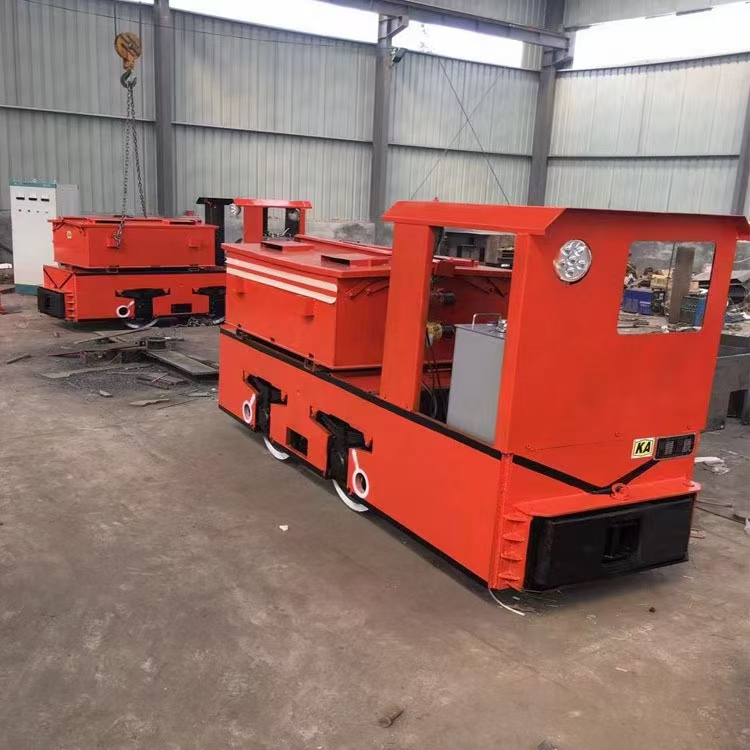
Shandong Mingshun Machinery Manufacturing Co., Ltd. is located in Qufu, Shandong. It is a physical manufacturing enterprise integrating R&D, production, and sales, with a plant area of more than 21,000 square meters and 18,000 square meters of workshops and warehouses. In its public materials, the company describes technological and quality innovation as the foundation of the enterprise, emphasizes monitoring and absorbing publicly available industry technological achievements, continuously developing products that meet market needs, and attaches importance to talent reserves and supporting capability development. For its custom-built new energy mining electric locomotive business, its product range covers two links: ore loading and transportation. Ore loading equipment includes skid-steer mucking loaders, crawler large-slope mucking loaders, milling excavators, underground small skid-steer loaders, rock loaders, and electric scraper winches; transportation equipment includes 1.5T–20T trolley wire electric locomotives, 2T–12T battery electric locomotives, crawler transport vehicles (“four-not-like” multipurpose vehicles), and new energy lithium-battery electric tricycles. The practical significance of this product range is that customization requirements can be considered uniformly at the interface between rock loading and transfer, for example, matching the operating height, haul distance, and overall dimension clearance between mucking loaders and transfer vehicles, thereby reducing interface rework caused by segmented procurement.
In customized cooperation, the user party is usually required to provide roadway and track survey data, operating cycle records, and power supply and charging conditions; on this basis, the supplier provides a complete vehicle layout and power matching scheme, and the acceptance operating conditions and determination methods are stipulated in the technical annex to the contract. It should be noted that the enterprise's specific qualification certificates, explosion-proof type, and safety mark certificate numbers shall be subject to the supporting documents provided by the enterprise, and the purchaser should verify each item before signing the contract. This guide does not confirm any undisclosed qualification information on behalf of the enterprise, nor does it make any performance commitments beyond the technical documents. For more information, please seeOfficial Website of Shandong Mingshun Machinery Manufacturing Co., Ltd.。
【FAQ】The following are frequently asked technical questions in the custom-made and acceptance processes. The answers focus on verification actions and judgment methods and do not provide uniform values.
A1: It is recommended to prepare at least six categories of input—track gauge and gradient, roadway cross-section and clearance envelope, curve radius, haulage distance and shift cycle records, load form and loading/unloading methods, and power supply and charging conditions (including charging locations and available duration). In addition, fault and maintenance records of existing equipment should be attached as a reference for reliability design. The more complete the input, the smaller the deviation in vehicle layout and power matching, and the lower the cost of subsequent changes.
A2: The supplier may be required to issue an energy consumption calculation report and specify the assumptions (load, gradient, transport distance, auxiliary power consumption, etc.); the contract shall stipulate the on-site verification methods and record format for full-load and slope conditions; check the consistency between factory test records and on-site measured data; for the battery pack, the test report may be checked against the clauses related to power battery pack testing in the GB/T 31467 series. It is not advisable to judge solely on the basis of the nameplate or promotional materials; verification conclusions should be based on written records.
A3: First, confirm that the explosion protection and protection type of the equipment match the hazardous area classification of the place of use, and verify the consistency between the nameplate markings and the safety mark certificate; the relevant standard system may refer to the GB/T 3836 series "Explosive atmospheres." Second, confirm the connection between the location of the charging chamber, the charging duration, and the shift system. Third, confirm that the ambient temperature and ventilation conditions are within the permissible operating range of the battery pack. Finally, confirm the mechanical protection, fixing method, and emergency power-off measures of the battery enclosure. All the above items shall be specified in the technical agreement.
A4: Documents supplied with the equipment usually include the operating instructions, general arrangement drawing of the complete vehicle and electrical schematic diagrams, factory certificate of conformity, safety mark certificate, and relevant test reports; at the same time, operating procedures and training arrangements, a spare parts list and supply cycle, fault response methods, and the definition of warranty scope should also be obtained. The completeness of the documentation directly affects the subsequent division of maintenance responsibilities; it is recommended that the list be specified in the contract and used as an acceptance condition.
The custom manufacture of new energy mining electric locomotives is essentially a system matching process that starts with operating condition inputs, rather than selecting from a number of ready-made models. The technical judgment can be advanced in four steps: first, organize the track gauge, gradient, haul distance, payload and shift schedule into reviewable input documents; second, determine the power supply type and powertrain architecture accordingly, and clarify the feasibility of trolley wire, battery or lithium battery solutions with respect to the charging regime and maintenance capability; third, check the layout and clearance limits across the five zones of the car body running gear, power source, electric control, braking and auxiliary systems; fourth, incorporate compliance verification and acceptance conditions into the contractual technical annex, so that the safety mark certificate, explosion-proof mark, factory test records and measured data form a closed loop. For the purchaser, verifiable documents and reproducible test records reflect the supplier's engineering capability more than a single indicator; for the supplier, the completeness of the operating condition inputs directly determines delivery quality. When selecting a custom manufacturer of new energy mining electric locomotives, it is recommended to simultaneously evaluate product portfolio coverage, interface coordination capability in the loading and transport phase, and spare parts support arrangements, and to complete an item-by-item verification of qualifications and certificates before signing the contract, so that the technical solution, compliance documents and acceptance standards are consistent, thereby reducing operation and maintenance risks throughout the life cycle.